Sunday, March 8, 2015

Interpretative sign workshop

Last week we talked about interpretative signs (post from March 4) and we broke into teams address some potential projects. The 4 teams gave presentations on their ideas the following day and they were really outstanding!

Team 1: Dong Nai Biosphere Reserve staff (I call them "Team Dong Nai") were to design a welcome sign for visitors.  They did it old school style- drawing with pencil and paper.


Design: large, 2-sided stone monument. It includes the logo of the Biosphere (elephant and tree), and the shape is the shape of the reserve. It has English and Vietnamese text with one side WELCOMING visitors and one saying GOOD BYE we hope to see you again.  I like it! And since I visited the Reserve since seeing this design last week, I agree with them that a welcome sign like this at the entrance would be very welcome. 

Team 2: This team's job was to take a critical look at the green, 3-paneled sign at the Cat Tien National Park entrance.  They did came up with 6 (or 7?) very specific improvements, including but not limited to: 
*The inspirational quote about forest conservation should be larger and in VN/ENG.
*The text needs to have more contrast from the background, so it's easier to read
*It's redundant to have a big map of the park here since the map is available in several other places throughout the park, this space could be used for other purposes
*Remove a "clutter" sign about campfire restrictions
*Make the way finding part much bigger (directions to the park reception office and private guest houses).
*I need to get a copy of their presentation because they really nailed it!

Team 3: Their assignment was to choose 2 topics that could be displayed outside the park headquarters.There is a lot of under-utilized space there, with some empty display cases or cases that have faded signs.  They chose to focus on pygmy lorises and yellow cheeked gibbons, two very rare primates that are found in Cat Tien.


Sign 1 message: Why is the yellow cheeked gibbon so special? It only lives here, they have interesting family units, and HELLO, they are awesome.


Sign 2 message: Wildlife are not pets, especially the pygmy loris. The illegal pet trade is a huge threat to wildlife conservation. So even though the pygmy loris is adorable, do not keep them as pets.


These are just some snapshots of the projector screen. The loris is saying "my home is he forest, I am not a pet!" Love it.

Team 4. This group's assignment was to pick 2 subjects for interpretive signs that would be located inside the visitor center.  There is more display space inside the visitor center (notice that sometimes I call it reception or headquarters, and sometimes "visitor center?" It needs a stronger identity... something to consider) since some of the furniture was rearranged. I think we'll come back to that conversation later.

The team chose 2 subjects: Crocodile Lake and the park's popular night safari tour.


The first sign explains the story of the successful re-introduction of the wild crocodile to Crocodile Lake. Crocodile Lake is a gorgeous wetland in the center of the park. Crocodiles went extinct here, but now they have been successfully re-established. The message: we fixed this situation but let's not let the problem happen again. Wildlife want to stay in their homes! And by the way, Crocodile Lake is internationally recognized for  its conservation status.

The second sign discusses the night safari, emphasizing the difference between viewing captive animals and seeing animals in nature.  I did not a picture of it because I was starting to feel a little obnoxious but it was a good sign. 


I want to get all these files and maybe fiddle with them a little bit, and have the posters made for the park. Stay tuned.

Friday, March 6, 2015

Cat Tien National Park Museum

Cat Tien National Park has a museum. It's tucked away in one of the administration buildings, not fare from the entrance to the Wildlife Rescue Center. I loved going in there. And I wish I had time to work on the museum alone several weeks.

The CTNP museum faces similar situation as the Zoological Museum as the University of Montana, and probably the same problems as many small museums around the world:

Lack of funding, lack of space, need for interpretation (non technical signs and labels). Ongoing challenges for care and maintenance of the specimens.

It seemed like a secret treasure chest and I'm so glad we went in.

They've displayed the skeleton the last rhinoceros that lived in the Park, whose body was found in 2011. This species is now extinct in Vietnam.  My understanding (which is often wrong here) is that this is the skeleton of the actual last rhinoceros. Looking at it with this information made me feel EMOTIONS. Anger, sadness, hopelessness, impressed that such an unlikely animal existed in the first place, a strange out of body experience that I could be so close the body of this famous individual rhino.

There were monkeys, hornbills, pickled fish and amphibians, some bears, some guar remains, and an impressive insect collection that probably doesn't even scratch the surface of the park's biodiversity but is stunning.  


I suggested that we take some pictures of the pinned insects and put the pictures in the Ecotourism center to promote visitors to the museum.

 The museum needs a source of income. Tourists can buy a ticket to visit the museum but I don't know how many people go there.  I am also not sure how all the park departments get their revenue. 

Maybe Emilie Graslie of the Field Museum could come and fix it up. I thibk an artist in residence be a huge benfit here. Must look for funding sources. 

Thursday, March 5, 2015

Websites, big tree mapping and so much more

Last night, we went on the park's night safari tour. We saw rabbits, a fisher, a mouse deer, dozens of sambar deer, a long tailed night jar (which is a cool bird), and one domestic  house cat (they are a conservation problem here too).

We started this morning with a discussion of the parks' websites, discussing what is good about each one and what things could be improved. For example, some parks' websites clearly state the price of package tours (which I think is important) and others do not list package tours. People had good ideas and strong opinions which is appreciated.


We also talked about Facebook marketing and other social media platforms. Twitter and Instagram are apparently not as popular in VN. MySpace is over. Dr. Khahn asked me if we should start using Twister, which confused me because I had not even heard of it, but I googled the interwebs and it's a real thing.  Facebook is popular here, but people had different opinions about who was using it and for what purpose; probably because there are a lot different kinds of audiences using Facebook for a variety of uses. I like it to post pictures of my cats and see what the Governor is up to.

All the parks have Facebook pages but not all are in English. We talked about how often to update, whether it should be detailed information just a pretty/interesting photo, etc. Each of the parks’ staff members shared their FB and webpage info.

Of course we talked about the universal obstacles to good web presence: time and clear delegation of duties. I struggle mightily with these in my University work; everyone does. There is no simple fix for those 2 problems, except having money to dedicate staff time to work on it.  I enjoyed looking at all the websites with them.

I’m not sure why I am unable to find the Cat Tien National Park FB page.  Maybe if one of my CTNP friends reads this blog post they can send me direct url in the comments section. Maybe because it is marked as Vietnamese language? I’m not sure but I think that a good and simple FB would really help connect tourists/travelers to the park. I’m having the same problem with Yak Don and Bidoup National Parks’ FB pages.

Here is the FB page for Dong Nai Biosphere Preserve https://www.facebook.com/pages/Dong-Nai-World-Biosphere-Reserve/291221094409894. Please show them some love and like their page!

I think all 3 parks’ websites come up easily with a Google search. Staff pointed out that there are several private hotels/tour companies just outside the park, and many of them have stronger websites, and this is a “pull” of tourists away from the park lodging and tour guides.  We’ve had some conversations about whether the relationship between private businesses and the government park agency. Big topic.

People shared their group projects, which was to design some interpretative signs (this will be its own post). LOVED IT. You will also love it. Preview: gibbon info.


We visited the park museum which was really fascinating (it will be its own post later).

After lunch, a subset of the group discussed how to go about GPS mapping the “big trees” in the park. There are 7 species of trees that have special conservation status and the park needs a map of them.  Sounds straightforward. However, (a) the jungle is really dense and (b) the park is really huge and (c) measuring Diameter at Breast Height...? We did not resolve the methodology issue but we’ll discuss again on Tuesday when Mr Tan and I return from Bien Hoa.

Also, Mr Tan and I are in Bien Hoa. It's a city about an hour outside Ho Chi Minh City, where the Forestry University is located. My host Professor Tuyen invited us to dinner in the faculty restaurant, where we totally got the VIP treatment.  Food sensory overload. My favorite thing was learning about “Century Eggs” which are beautiful and taste like fresh-laid and hard boiled eggs.  Read about it here. http://rojosgourmet.blogspot.com/2008/05/really-its-gourmet-1000-year-old-egg.html


Tan and Tuyen tell me that it’s extremely common in south Vietnam. Maybe I can learn this technique and apply it to our backyard chickens in Missoula.

 Thank you Dr. Tuyen for a lovely evening and warm welcome to the Forestry University!  Dr. Tuyen works in applied sustainable agriculture methods, I enjoyed hearing about his research and extension work in multi-crop systems for increased yield and soil conservation.  Looking forward to meeting more faculty and students tomorrow.


Wednesday, March 4, 2015

Interpretative signs at the Cat Tien Park Headquarters

Today we discussed interpretative signs, and specifically the style, content and location of signs at the Park Headquarters. We started with a 2010 assessment (by WWF) of the park's sign system. It was outdated (many of the issues- but not all- of the issues raised in the assessment had been addressed since the Park received the report about 4 years ago.


Can I just say: interpretative signage is difficult. It is. How do you communicate your message immediately, in a way that makes the reader want to learn more? How much text do you include? What size font and how many pictures? Who is your audience and how will they be feeling when they see a particular sign? How do you WANT them to feel?

For example, say you just arrived at Cat Tien National Park by boat, after a long bus ride from Ho Chi Minh City, and you need a bathroom and you are worried about whether your reservation is intact. It might not be the best moment to stop and read an educational sign. You probably want some wayfinding information.

Later, after you've had some Vietnamese ice coffee in the Golden Bamboo Cafe, and successfully made arrangements to go on a night safari, you might feel inclinded to loiter around the main office and learn about why wetlands are so important for biodiversity in southeast Asia. Or learn about foraging behavior of the yellow cheeked gibbon, which happens to live right here in Cat Tien and almost no where else on Earth.

So we looked at a lot of signage with a critical eye- some is great, some could be better or in a different location, and some opportunities could be better used (some blank walls at the reception area, for example).

We divided into groups and each group took a task:

Group 1: This group is from Dong Nai Nature Preserve (they have wild elephants!) and their assignment was to develop some interpretative signage welcoming visitors to their park.


Group 2: Critical edit of the main sign at the boat ramp (main entrance to the park)

Group 3: Choose 2 educational topics that could be displayed outside the park reception area (they choose to focus on the biology/conservation of pygmy loruses and yellow cheeked gibbons)

Group 4: Choose 2 educational topics that could be displayed inside the park reception area (they chose to focus on the Park's wetlands and on nocturnal animals of the park that you can see on the night safari)

It seemed like people got right to it, and I look forward to hearing their presentations tomorrow.


After the workshop, Dr. Khahn invited me and Tan to tour the Wildlife Rehab Center here at the Park Headquarters. They have lots of animals that were confiscated from illegal farms (Bear Farms?What?) and the illegal pet trade, as well as injured animals. Some of the animals will eventually be released to the wild, but not all.
It was really amazing to see some of these animals (Asiatic black bear and Malayan sun bear) gibbons, a leopard that had been kept as a house pet, some peacocks which are wild here by the way, crocodiles and civets. They had very clear interpretative signage also.
I will certainly remember to not buy a bear because it is illegal. 
They also have a center for growing rare orchids. It broke my heart to see them in captivity but I know they will be taken care of!


Thank goodness for Mr Tan

Unfortunately I don't speak Vietnamese. Fortunately my friend Mr Tan Vo, from Can Tho City,  was available to come and work as our interpreter. I figured that Dr. Khahn and I would need some help with interpretation (and in general) since Khahn is very busy arranging the schedule and logistics for the training course. That is  in addition to his regular work, so if he had to also mind me the whole time, he would probably leave.

Not only is Tan a great translator, he is a photographer AND has some great ideas about marketing the Park. Thanks Tan!

Interpretation: the difference between information and meaning

Today's subject was the importance of education for conservation. A universal truth is that politics or social pressure can stop conservation efforts almost any time. If this happens, it's a shortcoming of those of us working in conservation for having failed to educate appropriately.

Topics included: Know your audience, know your message, know yourself (whether it's you or your agency, NGO, etc).  Realize that although hearing and seeing are valuable ways of learning, they are not as powerful as experiencing or participating.  I gave some examples of experiential learning from my work in Missoula. I think people liked this, at least several people told me they liked it. I shared the two popular sayings in conservation education:

1) We conserve what we love, we love what we understand, we understand what we are taught (usually credited to Baba Dioum, Senegalese conservationist)

2) Tell me and I forget, show me and I remember, involve me and I learn (which is credited to everyone from Abraham Lincoln to Chinese proverbs. It just makes sense though)

We talked about the difference between giving people information and interpreting something in a way that is meaningful. Example: this is a saguaro cactus.


Versus: this saguaro cactus is like a hotel! (this is my all time favorite interpretative sign, I think it is from the Phoenix Botanical Garden).

We talked about using pictures and stories instead of data and text.

I shared my opinion that while the brochure describing the park tours had very good descriptions, it would be an improvement if the descriptions were on the webpage, together with pricing, duration, and perhaps some packages so that people could choose pre-planned bundles that fit their schedule, budget and interest.  Now, people don't get the menu of options until they arrive at the park and I think that this hinders foreign visitors from coming and staying for very long.

We assigned teams and homework for the participants to plan packages for day tourists, over-nighters, 3 days, 4 days and 5 days visitors. There was some heated discussion about the 5 day visitor idea. The thought here is that tourists can see all the activities in 3 days.  I feel that if people had some more options they would stay longer.

I asked people to do a list of Top Ten Experiences from their national park. There were some good lists. They got written down somewhere and I hope to develop the ideas a little more with the class participants, and then share them here. I stole the idea from this issue of Montana Outdoors.


Monday, March 2, 2015

First Day

I've arrived safely, reunited with my Fulbright host Dr. Khanh and Tan and Tran Vo from CanTho City.


I have met Khahn's wife and grandson and eaten spicy snails. We've checked into our beautiful guest house at Park Headquarters and had a productive first day. Saw some monkeys at lunch time on the Dong Nai River. No big deal.

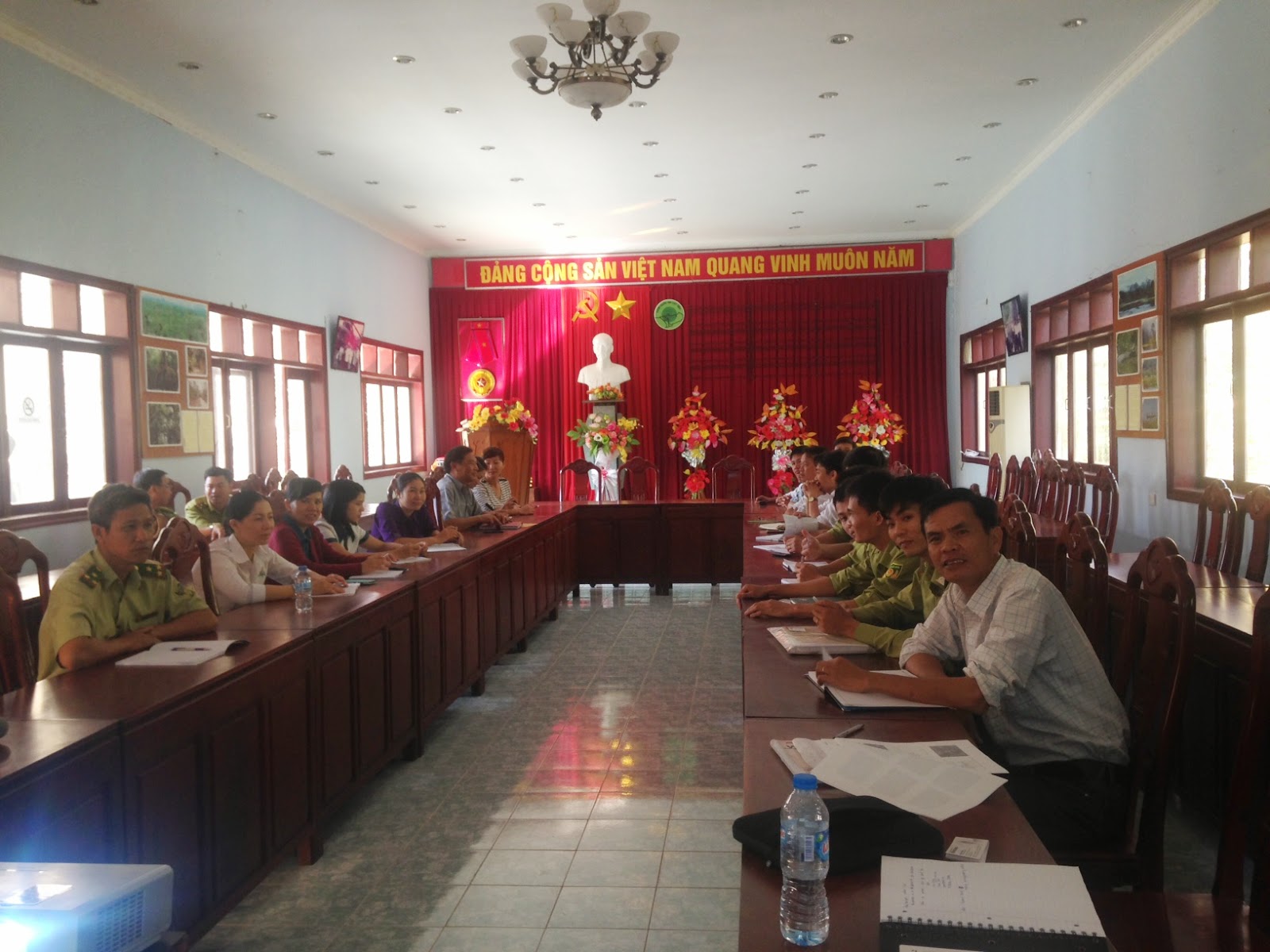
Here the conference room where a lot of the workshops will be happening (although we plan to move outside soon since the topic is park management and nature education). Yes it looks a little intimidating with the heavy furniture and such but I was made to feel very welcome. I gave a presentation about myself and work in Missoula grassland conservation and all the 38 participating park staff introduced themselves and stated their expectations for the training course.

I hadn't envisioned this as a Training Course per se, but the format is fine. We have 35 staff from Cat Tien National Park and then 2 staff from Yok Don National Park (known for elephants, and it has crazy high levels of biodiversity of plants and birds), and one research associate from Bidoup National Park. Bidoup has about 300 species of orchids, among other incredible features.

We talked a bit about Strengths, Weaknesses,Opportunities and Threats for each of these 3 national parks. Clearly, biodiversity, scenery and activities were strengths. Recurring weaknesses that staff identified were English skills, guide training, and attracting tourists. Unclear relationships with private tour operators was an issue- there are private businesses catering to nature tourists and in some aspects this is fine, but in other aspects it seems like a conflict. I look forward to talking more with people about that.

What made a big impression on me today was that when the power went out in the conference room (several times actually), whoever was speaking would just offer to sing a song.
In this case a children's song about a baby elephant in the central highlands of Vietnam (where the park is located).  Completely wonderful. I remember now that singing is more of a normal part of life in Vietnam.

Tonight I'm meeting half the participants in the Golden Bamboo Canteen at Park Headquarters for the beginning of "English Cafe." I'm trying to organize a program where English speaking park visitors are invited regularly to visit with parks staff in an informal setting to practice conversational English.
I am optimistic.

If you are traveling to Cat Tien National Park and looking at this blog, please enquire of Parks staff about volunteering to hang out and speak English in the cafe after your day of trekking in the jungle looking for birds and monkeys.  See you there!